

Table of Contents

Imagine upgrading your gaming PC, launching your favorite game at 4K, and finally enjoying the detailed environments, realistic lighting, and smooth gameplay you’ve been chasing. No constant compromises between image quality and performance. Just a powerful graphics card doing what you bought it to do.
That’s the experience the NVIDIA GeForce RTX 4090 was designed to deliver.
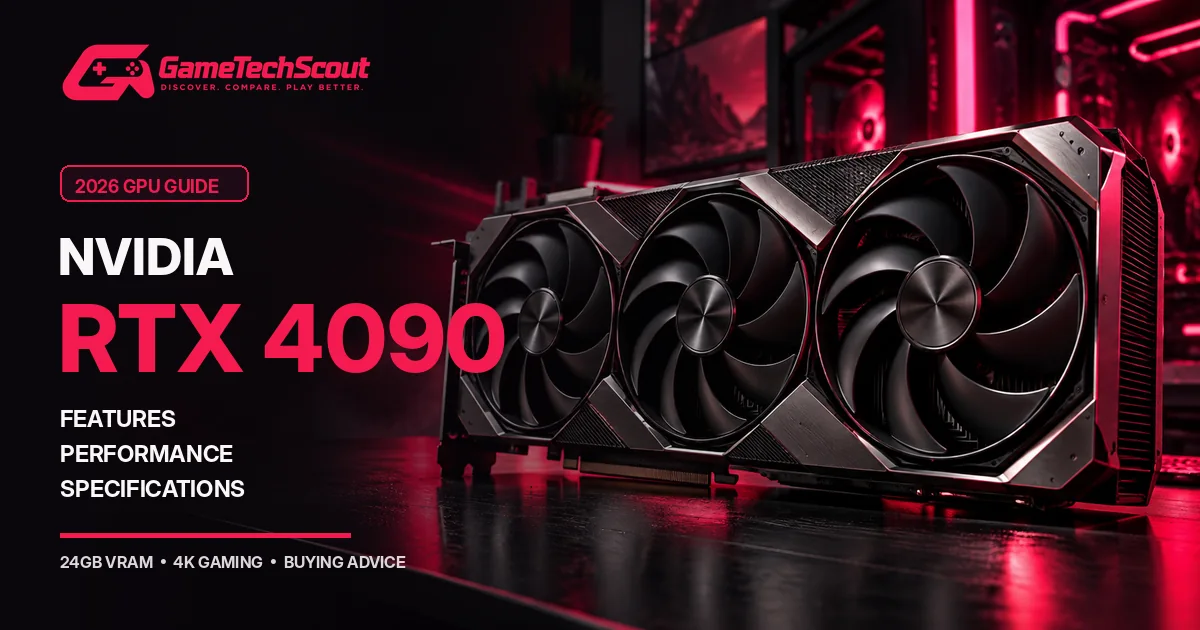
When it launched in October 2022, the RTX 4090 raised expectations for high-end gaming. With 24GB of GDDR6X memory, 16,384 CUDA cores, and NVIDIA’s Ada Lovelace architecture, it offered tremendous performance for gamers and content creators.
But hardware moves quickly. In 2026, the RTX 5090 and RTX 5080 have changed the buying landscape, while the RTX 4090 remains a powerful option for demanding workloads.
So, is the RTX 4090 still worth your money?
In this guide, you’ll discover the RTX 4090 specifications, gaming performance, features, power requirements, and buying considerations. We’ll also compare it with newer NVIDIA GPUs so you can make an informed decision before upgrading your PC.
What Is the NVIDIA GeForce RTX 4090?
The NVIDIA RTX 4090 is a high-end desktop graphics card built on the Ada Lovelace architecture. It was released on October 12, 2022, with an original starting price of $1,599.
Designed for enthusiast gaming and GPU-intensive creative applications, it combines extensive processing resources with a large memory capacity.
Unlike midrange graphics cards intended mainly for 1080p or 1440p gaming, it was developed with demanding 4K workloads in mind.
It remains relevant for users who need:
- High-quality 4K gaming performance.
- Advanced ray-traced graphics.
- Large amounts of dedicated GPU memory.
- GPU-accelerated 3D rendering.
- Professional video editing and creative work.
- Compatible AI and machine-learning applications.
However, its high power consumption, physical size, and uncertain resale-market value mean that it isn’t the right GPU for every PC builder.
NVIDIA RTX 4090 Specifications
Understanding the technical specifications helps you decide whether the RTX 4090 meets your needs and works with your existing hardware.
RTX 4090 Technical Specifications Table
| Specification | NVIDIA RTX 4090 |
|---|---|
| Architecture | NVIDIA Ada Lovelace |
| GPU | AD102 |
| CUDA cores | 16,384 |
| Base clock | 2.23 GHz |
| Boost clock | 2.52 GHz |
| Video memory | 24GB GDDR6X |
| Memory interface | 384-bit |
| Memory bandwidth | 1,008 GB/s |
| Ray tracing cores | 3rd generation |
| Tensor cores | 4th generation |
| Interface | PCIe 4.0 x16 |
| Total graphics power | 450W |
| Recommended system PSU | 850W minimum |
| Display outputs | HDMI 2.1a, 3 × DisplayPort 1.4a |
| Founders Edition length | 304mm |
| Founders Edition thickness | 3 slots |
Source: NVIDIA GeForce RTX 4090 official specifications. Specifications refer to NVIDIA’s reference design; partner models can differ.
Why Does the RTX 4090 Have 24GB of VRAM?
VRAM, or video random-access memory, stores information the graphics card needs while processing visual workloads.
This includes textures, rendering buffers, geometry, and other game assets.
The RTX 4090’s 24GB memory capacity gives you substantial room for demanding gaming and creative applications.
For example, if you create detailed 3D scenes or work with large GPU-accelerated projects, additional VRAM may allow you to handle workloads that exceed the capacity of a 12GB or 16GB graphics card.
However, more VRAM doesn’t automatically mean better performance in every game. Some applications benefit mainly from processing power, while others are constrained by memory capacity.
Main NVIDIA RTX 4090 Features
The RTX 4090’s capabilities extend beyond traditional graphics rendering.
1. Ada Lovelace Architecture
NVIDIA’s Ada Lovelace architecture powers the RTX 40 Series.
It improves graphics processing, ray-tracing capabilities, and AI acceleration compared with earlier NVIDIA generations.
For you, these improvements support demanding game environments, complex lighting effects, and accelerated creative workloads.
The RTX 4090 combines a large number of CUDA cores with specialized hardware for ray tracing and AI processing.
2. Third-Generation Ray Tracing Cores
Ray tracing simulates aspects of how light interacts with objects and surfaces.
In supported games, it can improve reflections, lighting, shadows, and visual realism.
The RTX 4090 includes third-generation RT cores, helping it handle demanding ray-traced scenes.
However, even this powerful card can experience substantial performance reductions when you enable intensive ray-tracing or path-tracing settings.
You may still benefit from DLSS when playing especially demanding games.
3. DLSS and AI Frame Generation
NVIDIA DLSS uses AI-based technologies to improve gaming performance and image quality in supported titles.
The RTX 4090 supports DLSS Super Resolution, Ray Reconstruction, and Frame Generation.
Its Frame Generation technology can generate additional displayed frames between traditionally rendered frames.
Does the RTX 4090 Support DLSS 4?
Yes, but not every DLSS 4 feature.
The RTX 4090 can use supported DLSS 4 improvements, including newer AI models for Super Resolution and Ray Reconstruction.
It also supports updated single Frame Generation technology.
However, DLSS Multi Frame Generation is exclusive to compatible RTX 50 Series and newer supported hardware, not the RTX 4090.
This distinction matters when comparing advertised performance figures between RTX 40- and RTX 50-series GPUs.
For details, see NVIDIA’s DLSS 4 feature explanation.
4. NVIDIA Reflex
NVIDIA Reflex helps reduce system latency in supported games.
Lower latency can improve responsiveness between your mouse or keyboard input and the action displayed on screen.
For competitive gaming, that can be useful, particularly when you’re trying to minimize unnecessary input delay.
Remember that your monitor, game engine, CPU, and overall PC configuration also influence responsiveness.
5. AV1 Encoding and Creative Tools
The RTX 4090 includes two eighth-generation NVIDIA encoders and supports AV1 encoding.
AV1 can provide efficient video compression in supported recording, streaming, and editing workflows.
If you regularly create gaming videos, stream gameplay, or export content using GPU-accelerated software, the card offers capabilities beyond gaming performance alone.

NVIDIA RTX 4090 Gaming Performance in 2026
Gaming performance is where the RTX 4090 continues to impress.
Even four years after release, its processing power keeps it competitive with newer high-end graphics cards.
RTX 4090 Performance at 1080p
At 1080p, the RTX 4090 is considerably more powerful than most gamers need.
In many games, CPU performance or engine limitations can prevent the GPU from reaching its full potential.
You may benefit from its processing power in some high-refresh competitive scenarios, but buying an RTX 4090 exclusively for ordinary 1080p gaming generally offers poor value.
RTX 4090 Performance at 1440p
At 1440p, the RTX 4090 delivers excellent results in demanding games.
This resolution allows you to enjoy high visual quality without placing as much workload on the GPU as native 4K rendering.
For players using 1440p high-refresh monitors, the RTX 4090 offers substantial performance headroom.
Still, you’ll want to compare less expensive graphics cards before choosing it solely for 1440p gaming.
RTX 4090 Performance at 4K
4K gaming is one of the RTX 4090’s strongest use cases.
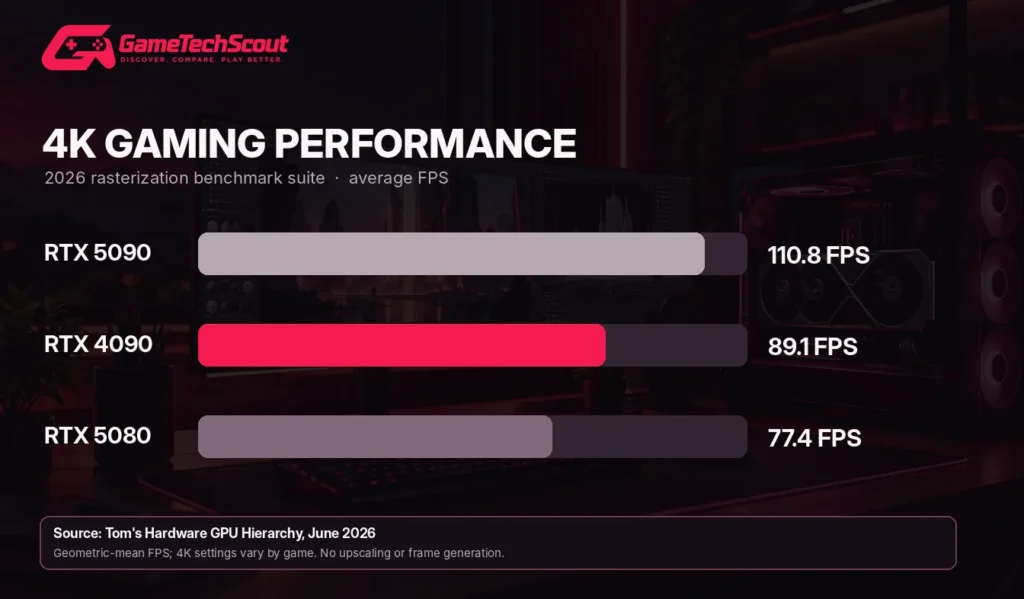
According to Tom’s Hardware’s June 2026 GPU benchmark hierarchy, the RTX 4090 achieved a combined score of 89.1 FPS in its 4K rasterization test suite.
For perspective:
| Graphics card | 4K rasterization score |
|---|---|
| NVIDIA RTX 5090 | 110.8 FPS |
| NVIDIA RTX 4090 | 89.1 FPS |
| NVIDIA RTX 5080 | 77.4 FPS |
Source: Tom’s Hardware GPU Benchmark Hierarchy 2026. Figures summarize multiple games using the publication’s test system and settings. They are not individual-game benchmarks and exclude DLSS/frame-generation comparisons.
These results demonstrate why the RTX 4090 remains attractive for enthusiast 4K gaming.
It performs above the RTX 5080 in this benchmark, although the RTX 5090 maintains a clear lead.
RTX 4090 Ray Tracing Performance
Ray tracing introduces additional rendering demands.
In the same 2026 Tom’s Hardware benchmark suite, the RTX 4090 recorded a 4K ray-tracing score of 52.2 FPS, compared with 42.1 FPS for the RTX 5080 and 64.1 FPS for the RTX 5090.
This doesn’t mean every ray-traced game will run at those exact frame rates.
Performance varies depending on game optimization, rendering resolution, CPU configuration, and the specific ray-tracing effects enabled.
For demanding titles, DLSS Super Resolution can be a practical tool for balancing image quality and responsiveness.
RTX 4090 vs RTX 5080 vs RTX 5090
If you’re considering purchasing an RTX 4090 in 2026, comparing it with newer NVIDIA graphics cards is essential.
RTX 4090 vs RTX 5080
The RTX 5080 uses newer Blackwell architecture and features 16GB GDDR7 memory.
The RTX 4090 offers 24GB GDDR6X memory, providing 8GB more capacity.
Tom’s Hardware’s 2026 benchmark suite also places the RTX 4090 ahead of the RTX 5080 in native 4K rasterization and ray-traced performance.
However, the RTX 5080 has a lower 360W reference graphics power rating and supports newer RTX 50-series features, including Multi Frame Generation.
Which should you buy?
Choose based on price, your workload, and the technologies you actually use.
If a reliable RTX 4090 is available at an attractive price and you need 24GB VRAM, it may remain appealing.
If you prioritize current-generation features, a new warranty, and reduced power requirements, the RTX 5080 deserves consideration.
RTX 4090 vs RTX 5090
The RTX 5090 moves into a higher performance category.
It offers 32GB GDDR7 memory and 21,760 CUDA cores, compared with the RTX 4090’s 24GB memory and 16,384 CUDA cores.
It also has higher power requirements.
| Specification | RTX 4090 | RTX 5090 |
|---|---|---|
| Architecture | Ada Lovelace | Blackwell |
| VRAM | 24GB GDDR6X | 32GB GDDR7 |
| CUDA cores | 16,384 | 21,760 |
| Graphics power | 450W | 575W |
| Original launch MSRP | $1,599 | $1,999 |
| Multi Frame Generation | No | Yes |
The RTX 5090 offers higher performance potential and greater memory capacity.
But that doesn’t automatically make it the best-value purchase. Actual retail prices, availability, and your needs should determine the decision.
RTX 4090 Power Consumption and PC Compatibility
Before buying an RTX 4090, make sure your PC can physically accommodate it and supply enough power.
RTX 4090 Power Supply Requirements
NVIDIA rates the RTX 4090 at 450W total graphics power and recommends at least an 850W system power supply for its reference configuration.
Depending on your CPU, overclocking, and other components, a higher-capacity power supply may be appropriate.
Choose a reliable PSU with the correct connectors and appropriate power headroom.
RTX 4090 Size and Case Clearance
The RTX 4090 Founders Edition measures:
- Length: 304mm.
- Width: 137mm.
- Thickness: approximately 61mm, occupying three slots.
NVIDIA also recommends allowing additional clearance around the card, including approximately 36mm for the power cable.
Some ASUS, MSI, Gigabyte, and other partner models are considerably larger.
What Should You Check Before Installation?
- Your case’s maximum graphics card length.
- Available expansion slots.
- Space beside the GPU for the power cable.
- PSU wattage and compatible power cables.
- Cooling and airflow inside the case.
- Compatibility with other components, such as front-mounted radiators.
Don’t force a power connector into a tight bend near the GPU.
Use properly rated cables and follow the power supply and graphics card manufacturers’ installation instructions.
RTX 4090 Price and Availability in 2026
The RTX 4090 launched at $1,599, but that historical MSRP shouldn’t be mistaken for its current selling price.
With newer NVIDIA generations on the market, obtaining an RTX 4090 often means investigating older inventory or second-hand listings.
Availability and resale prices can change quickly, especially for high-end graphics cards.
Should You Buy a Used RTX 4090?
A used RTX 4090 can be a reasonable option if the price reflects its age, condition, warranty status, and competition from newer GPUs.
However, expensive used hardware requires careful inspection.
Before purchasing:
- Ask for the exact manufacturer and model number.
- Request clear photographs of the actual card.
- Check its serial number and warranty eligibility.
- Obtain proof that the GPU works under load.
- Inspect the power connector for discoloration or damage.
- Look for unusual fan noise, overheating, or physical modifications.
- Use a reputable seller with buyer protection.
- Avoid suspiciously cheap listings and unverified sellers.
Counterfeit and component-swapped RTX 4090 cards have been reported. That’s another reason to avoid purchases you cannot independently verify.
Is the RTX 4090 Worth Buying New?
Only after comparing the actual price with current alternatives.
A high asking price isn’t justified merely because the card was once NVIDIA’s flagship.
Compare performance, memory requirements, efficiency, warranty coverage, and availability before committing.
Who Should Buy the NVIDIA RTX 4090?
Enthusiast 4K Gamers
If you want high-resolution gaming and already own a compatible high-end PC, an RTX 4090 can still deliver excellent results.
It becomes more appealing if you find a reliable unit at a competitive price.
Video Editors and 3D Artists
The RTX 4090 can be valuable for GPU-accelerated rendering and editing.
Its 24GB VRAM is particularly useful for some large creative projects.
However, you should check the specific software’s GPU compatibility and memory requirements before investing.
AI and Machine-Learning Enthusiasts
The RTX 4090 can accelerate supported CUDA-based applications and local AI workloads.
Its 24GB memory capacity is useful for models and workflows that fit within that limit.
Larger models may still require quantization, memory offloading, or additional computing resources.
Who Should Skip the RTX 4090?
You probably don’t need an RTX 4090 if you:
- Primarily play games at 1080p.
- Have a limited PC-building budget.
- Own a power supply or case that cannot accommodate it.
- Don’t use GPU-intensive professional applications.
- Can purchase a more suitable new GPU at significantly lower cost.
NVIDIA RTX 4090 Pros and Cons
| Advantages | Disadvantages |
|---|---|
| Excellent 4K gaming performance | High 450W graphics power rating |
| Large 24GB VRAM capacity | Requires substantial case space |
| Strong ray-tracing performance | Can be expensive on the resale market |
| Useful creative and CUDA capabilities | No RTX 50-series Multi Frame Generation |
| Supports AV1 encoding | Used purchases require extra caution |
For many PC enthusiasts, the RTX 4090 remains impressive hardware. Whether it represents a good purchase in 2026 is a separate question.
Frequently Asked Questions About the RTX 4090
Is the RTX 4090 Still Good in 2026?
Yes. Independent 2026 GPU benchmarks show that it remains extremely capable for 4K gaming and ray tracing. Its buying value depends on current pricing and condition.
How Much VRAM Does the RTX 4090 Have?
The RTX 4090 has 24GB GDDR6X memory on a 384-bit memory interface.
What Power Supply Do You Need for an RTX 4090?
NVIDIA recommends a minimum 850W system PSU for its reference configuration. High-power CPUs and other components may require more capacity.
Is the RTX 4090 Better Than the RTX 5080?
In Tom’s Hardware’s 2026 native 4K gaming tests, the RTX 4090 outperforms the RTX 5080. However, the RTX 5080 offers newer-generation features and lower reference power consumption.
Is the RTX 5090 Faster Than the RTX 4090?
Yes. The RTX 5090 is faster in independent gaming benchmarks and has 32GB VRAM compared with the RTX 4090’s 24GB.
Does the RTX 4090 Support DLSS 4?
The RTX 4090 supports applicable DLSS 4 improvements, including compatible Super Resolution, Ray Reconstruction, and Frame Generation features. It does not support RTX 50-series Multi Frame Generation.
Is the RTX 4090 Good for 4K Gaming?
Yes. High-resolution gaming is one of its main strengths, although demanding ray-traced games may still benefit from upscaling.
Can the RTX 4090 Handle 3D Rendering and AI Workloads?
Yes, with compatible software. Its CUDA processing resources and 24GB VRAM make it useful for many GPU-accelerated applications, provided the workload fits the card’s capabilities.
Conclusion: Is the NVIDIA RTX 4090 Worth Buying in 2026?
The NVIDIA RTX 4090 remains one of the most capable graphics cards of its generation.
With 16,384 CUDA cores, 24GB GDDR6X memory, impressive 4K gaming performance, and support for advanced NVIDIA technologies, it still offers substantial power for gamers and creators.
However, you’re no longer choosing between the RTX 4090 and the graphics cards available in 2022.
The RTX 5090 offers higher performance, while the RTX 5080 provides newer features and lower power requirements.
The best decision comes down to what you need and what you’re actually paying.
If you find an RTX 4090 in excellent condition at a genuinely competitive price, it can still be a smart high-end upgrade. Otherwise, compare current-generation alternatives before spending your money.
Planning an RTX 4090 build? Check your PSU, case clearance, and cooling first. Then compare current GPU prices and independent benchmarks for the games or applications you use most.
Share your current graphics card, processor, and upgrade budget in the GameTechScout comments. Your configuration could help other PC builders make a better-informed decision.
GameTechScout — Discover. Compare. Play Better.
Editorial disclosure: This article is based on NVIDIA’s published specifications and independent third-party benchmark research. GameTechScout does not claim to have personally tested an RTX 4090. Product prices and availability should be verified before purchasing.

1 Comment